Track Overview & Pedagogical Value
Size constraints force designers to move past abstract digital modeling and confront real-world dimensional boundaries. In standard CAD environments like Tinkercad or Fusion 360, infinite digital space often leads students to create models without regard to scale, volume, or print bed limitations. By enforcing strict bounding boxes and maximum dimension envelopes, learners develop a critical eye for spatial relationships and functional ergonomics.
When working under rigorous dimensional boundaries, every millimeter carries structural and aesthetic consequences. Students learn to calculate internal clearance, wall thickness, and outer tolerances while preserving the core functionality of their prototypes. This category builds foundational measurement literacy, bridging digital coordinates with physical caliper verification.
Engineering Challenge Boundary
All design components must fit entirely within predetermined dimensional parameters—such as a 60 mm bounding cube or a strict 25 mm desk overhang—without exceeding outer perimeter thresholds.
Enforced Constraint Specifications
The entire assembled model must fit completely inside a predefined volumetric boundary (e.g., 50x50x50 mm) with zero component protrusion outside the designated perimeter.
Ensure structural walls maintain at least 2.4 mm thickness for additive manufacturing stability, while internal mating slots preserve a 0.4 mm sliding clearance.
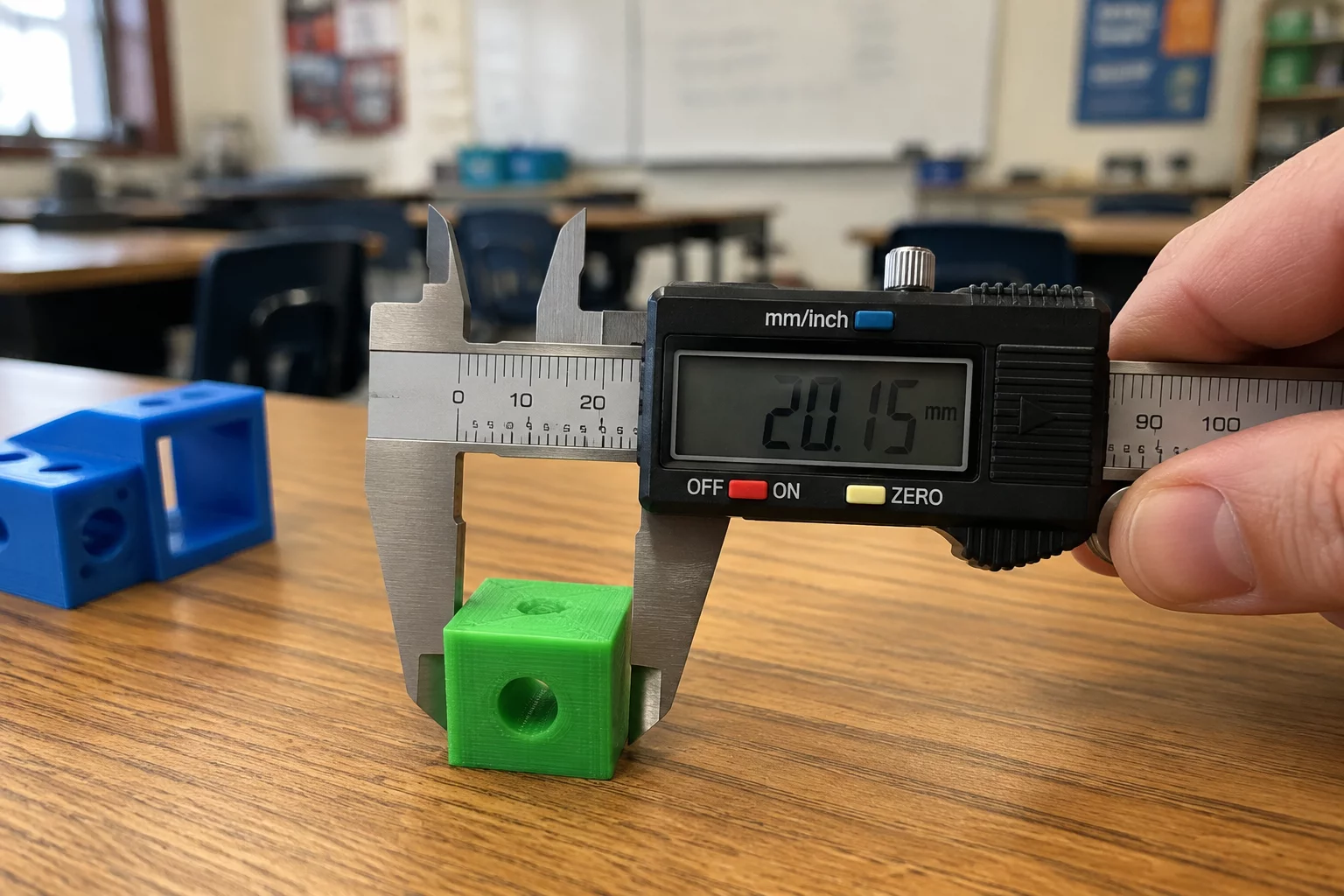
Physical printed iterations must match CAD software dimensions within a ±0.5 mm tolerance window when measured with manual or digital calipers.
Classroom & Makerspace Implementation
Deploying size-constrained challenges in a classroom or makerspace provides rapid print times and immediate physical validation feedback loops. Follow these systematic stages during a lesson:
- Establish strict bounding envelope limits using reference test cubes in Tinkercad or CAD software before sketching geometry.
- Check all critical dimensions against digital rulers prior to exporting STL files for 3D slicing.
- Verify physical prints post-production using digital calipers to measure shrinkage, warpage, and tolerance compliance.