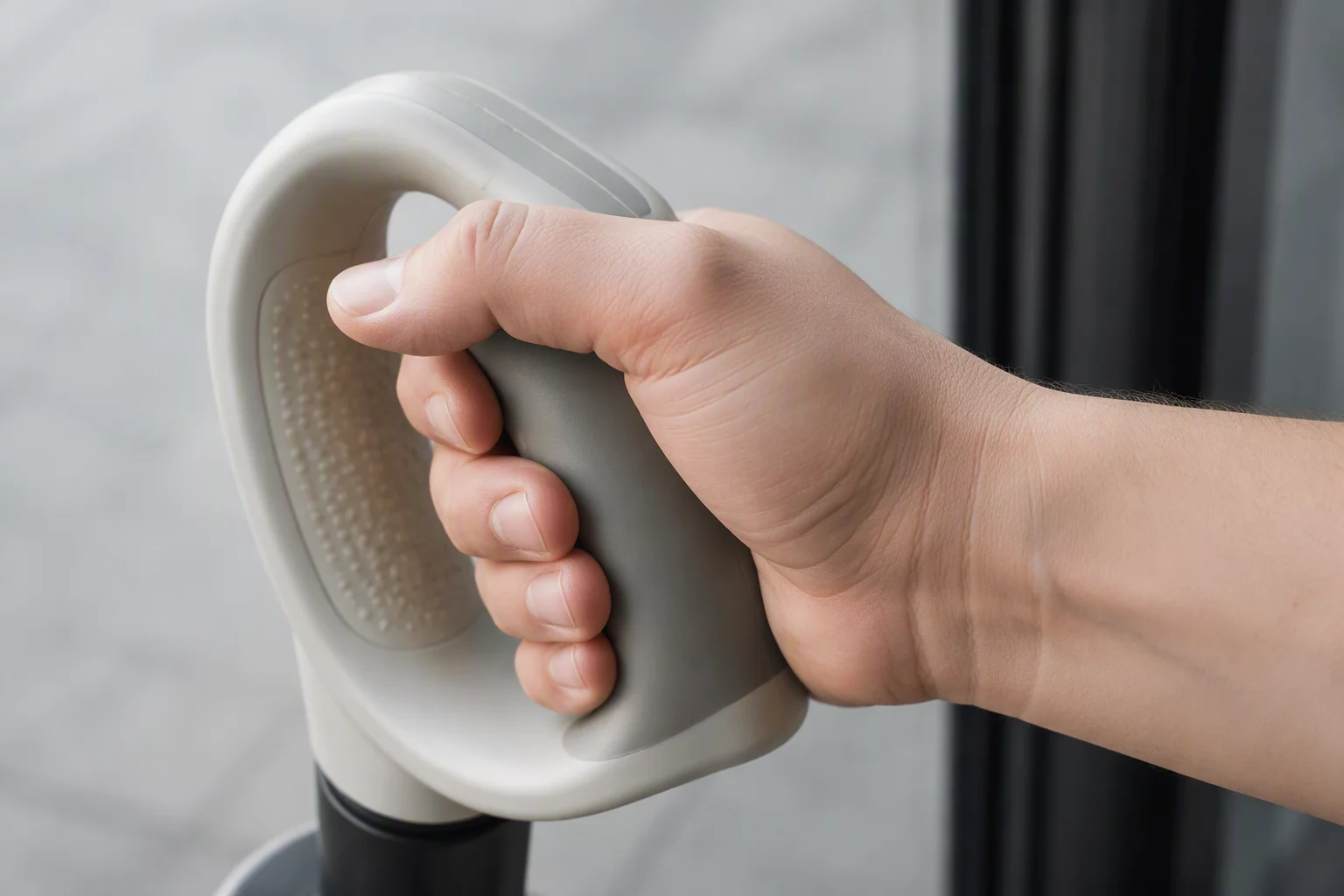
Track Overview & Pedagogical Value
User constraints force student designers to step outside their own physical habits and solve problems for specific anatomical requirements. When students model standard handles or tools, they default to their dominant hand and typical hand geometry without considering variations in grip strength, orientation, or finger span. Introducing explicit user constraints shifts CAD modeling from purely decorative shape manipulation to human-centered ergonomic problem solving.
In this track, students confront physical parameters such as asymmetric palm contours, single-handed operation requirements, or specialized tactile feedback zones. By building within these user-focused boundaries, students learn to measure physical hands, calculate natural pivot angles, and test prototypes against real human interaction rather than theoretical digital models.
Engineering Challenge Boundary
Every design submitted in this discipline must solve a primary physical task while satisfying at least two distinct user-specific parameters, such as full inverted left-handed ergonomics or zero-pinch palm clearance.
Enforced Constraint Specifications
The model must function exclusively and comfortably for non-dominant or specialized grip orientations, requiring intentional asymmetry in contouring.
The user must be able to engage, stabilize, and release the tool using only one hand without repositioning fingers during operation.
All resting surfaces that press against human skin must maintain a minimum edge radius of 3.5 mm to prevent acute pressure points and fatigue.
Classroom & Makerspace Implementation
Deploying user constraint challenges in classroom makerspaces connects digital modeling directly with physical validation testing. Follow this structured protocol to run the activity:
- Measure target user hand anatomy using calipers and clay impressions before launching Tinkercad or Fusion.
- Draft initial ergonomic shells using boolean grouping and test 3D printed draft slices within 45 minutes.
- Conduct blindfold and non-dominant hand validation trials to evaluate tactile usability under real-world conditions.