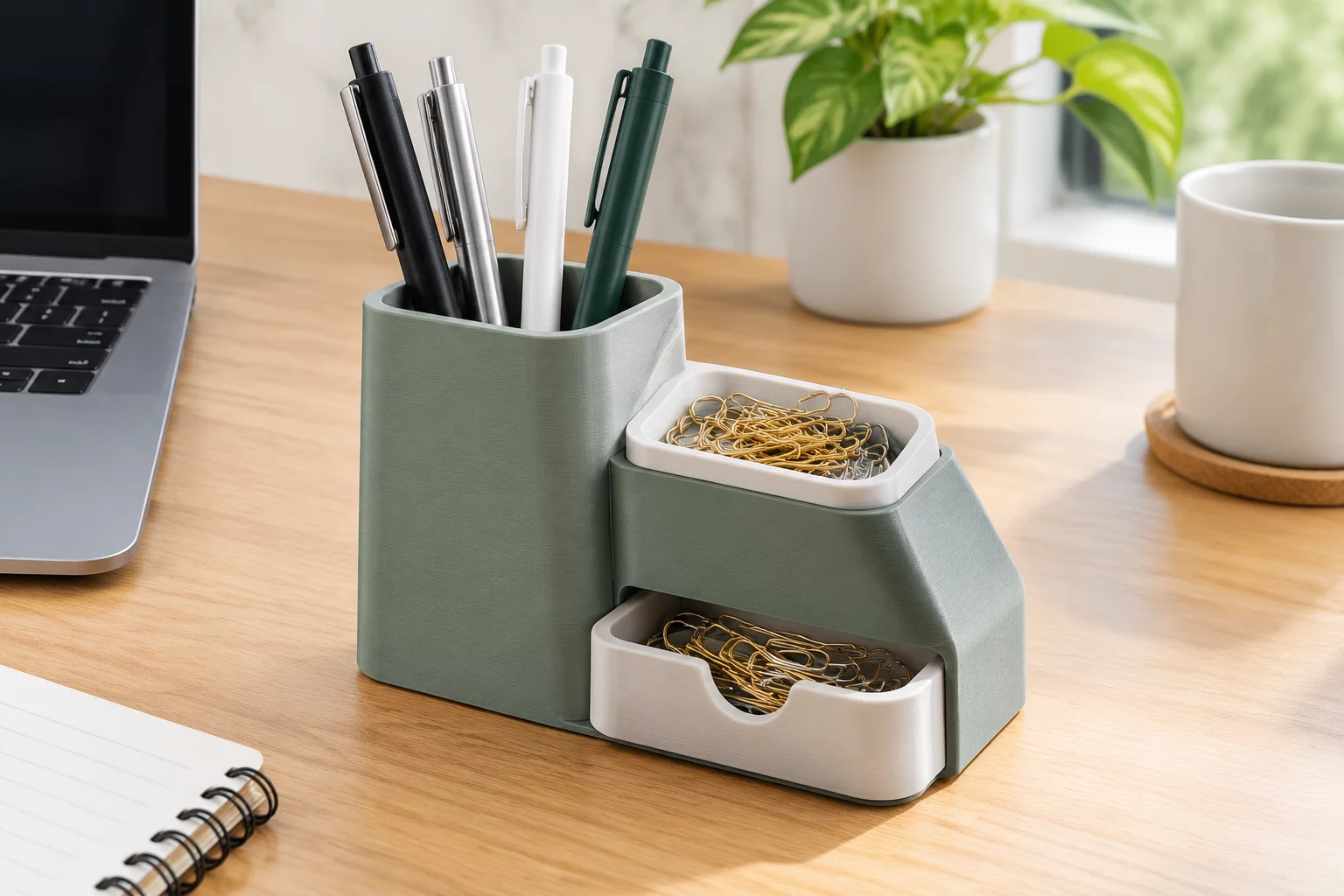
Track Overview & Pedagogical Value
Storage challenges force students and makers to confront volume limits head-on. Designing a functional container is not just about making a hollow box; it requires careful evaluation of inner partition sizing, wall thickness rigidity, and clearance margins for everyday objects. When working within an immovable dimensional envelope, every millimeter subtracted by an unnecessary wall directly reduces useful storage capacity.
In this track, participants construct modular desk trays, customized tool caddies, and interlocking compartment grids using Tinkercad or Fusion 360. By restricting external bounding dimensions while specifying target contents like dry-erase markers, USB flash drives, or sticky notes, designers learn to balance external volume constraints against internal functional ergonomics.
Engineering Challenge Boundary
All submissions must fit entirely within an absolute 100 × 80 × 50 mm volume envelope. The design must accommodate at least two distinct classroom tool profiles without internal rattling or wall deformation during handling.
Enforced Constraint Specifications
The overall bounding box cannot exceed the prescribed maximum width, depth, and height, ensuring the final piece fits target drawers or desks.
Interior slots must precisely match the measured geometry of targeted objects with standard 0.8 mm clearance tolerances.
Minimum perimeter wall thickness is held at 1.6 mm (4 nozzle perimeters) without requiring internal support structures on flat build plates.
Classroom & Makerspace Implementation
Deploying storage challenges in classrooms and makerspaces turns abstract measurement exercises into concrete physical products. Follow this streamlined workflow during group sessions:
- Measure physical classroom tools with digital calipers, recording exact length, diameter, and taper margins.
- Construct negative cavity shapes in CAD and perform boolean difference cuts into the primary bounding block.
- Verify print time and material usage in slicing software before printing a physical prototype for fit testing.