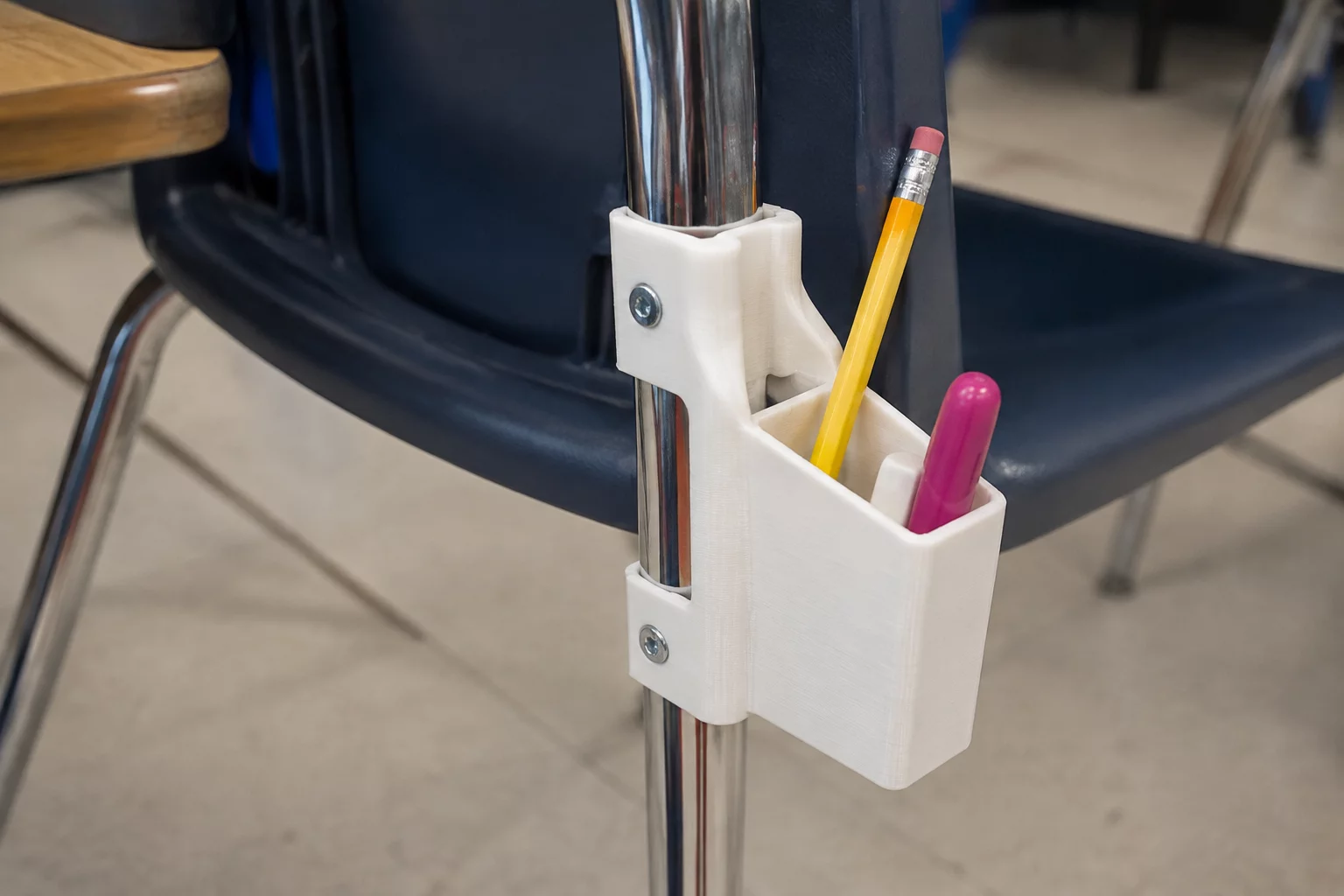
From Theoretical CAD to Tangible Classroom Utility
When students first open 3D modeling software, their instinct is often to construct decorative novelties—fidget spinners, superhero keychains, or miniature game tokens. While these items spark initial excitement, they rarely teach rigorous mechanical thinking. Introducing real classroom friction points, such as wobbly desk legs, tangled headphone cables at charging stations, or lost whiteboard markers, shifts the entire educational dynamic. The moment a learner measures an actual table leg with a physical caliper, the computer screen stops feeling like a digital canvas and starts operating as a precision drafting table.
In our middle school makerspace, we tested this shift by restricting student design prompts to objects that could be deployed within the school building itself. Instead of receiving open-ended instructions to "design an organizer," students had to inspect room 204, interview teachers about storage headaches, and produce functional brackets that conformed strictly to existing school furniture. This constraint grounded their creative impulses in actual physical laws, structural tolerances, and material performance.
When students build for an actual physical environment with rigid boundary conditions, every millimeter suddenly carries purpose and accountability.— Mike Torres, STEM Curriculum Coordinator
Targeted Constraint Strategies That Elevate Student Solutions
Directing students toward real-world problems requires clear bounding envelopes so their CAD files do not turn into oversized, unprintable plastic monoliths. We establish four mandatory design boundaries before anyone creates their first sketch:
- Dimensional Envelope Bounds: Every design must occupy a bounding volume smaller than 70 mm on any axis, reducing print duration to under 45 minutes and ensuring rapid testing cycles during class periods.
- Non-Invasive Attachment: Objects must clamp, friction-fit, or slide onto school furniture without requiring adhesives, screws, or permanent structural alterations to classroom assets.
- Mechanical Load Orientation: Students must identify print layer orientation upfront, ensuring shear forces act perpendicular to the build plate rather than delaminating layer lines under load.
- Geometric Simplicity Rule: Models can use a maximum of four primitive solid shapes in Tinkercad, forcing elegant Boolean unions and subtractions rather than disorderly mesh stacking.
These parameters prevent the common trap of infinite digital freedom. When students realize that excessive plastic infill wastes workshop filament and increases print failures, they naturally gravitate toward ribbing, chamfers, and lightweight skeletal geometry.
The Three-Phase Problem-Solving Workflow
Facilitating this workflow in an active 50-minute STEM period requires an orderly progression from physical measurement to digital synthesis. We organize classroom projects across three systematic milestones:
- Physical Site Audit and Caliper Validation: Students work in pairs to measure target furniture edges, recording millimeter tolerances in engineering notebooks and noting clearance obstacles.
- Parametric Sketching and Low-Fidelity Mockups: Cardboard or cardstock mockups precede any 3D modeling, allowing students to test friction fits and snap joints before sending files to the print queue.
- Iterative Fabrication and Live Classroom Testing: The printed part is snapped into position on the physical desk or whiteboard rail, immediately highlighting where tolerances must expand or contract by 0.3 mm.
By closing the loop between design intent and physical performance, students discover that engineering failure is merely diagnostic data. A hook that snaps under a backpack's weight does not earn a failing grade; it sparks an instant geometric revision to increase fillet radii and adjust internal infill density.
Discussion & Peer Reviews
No comments yet. Be the first to leave a comment.