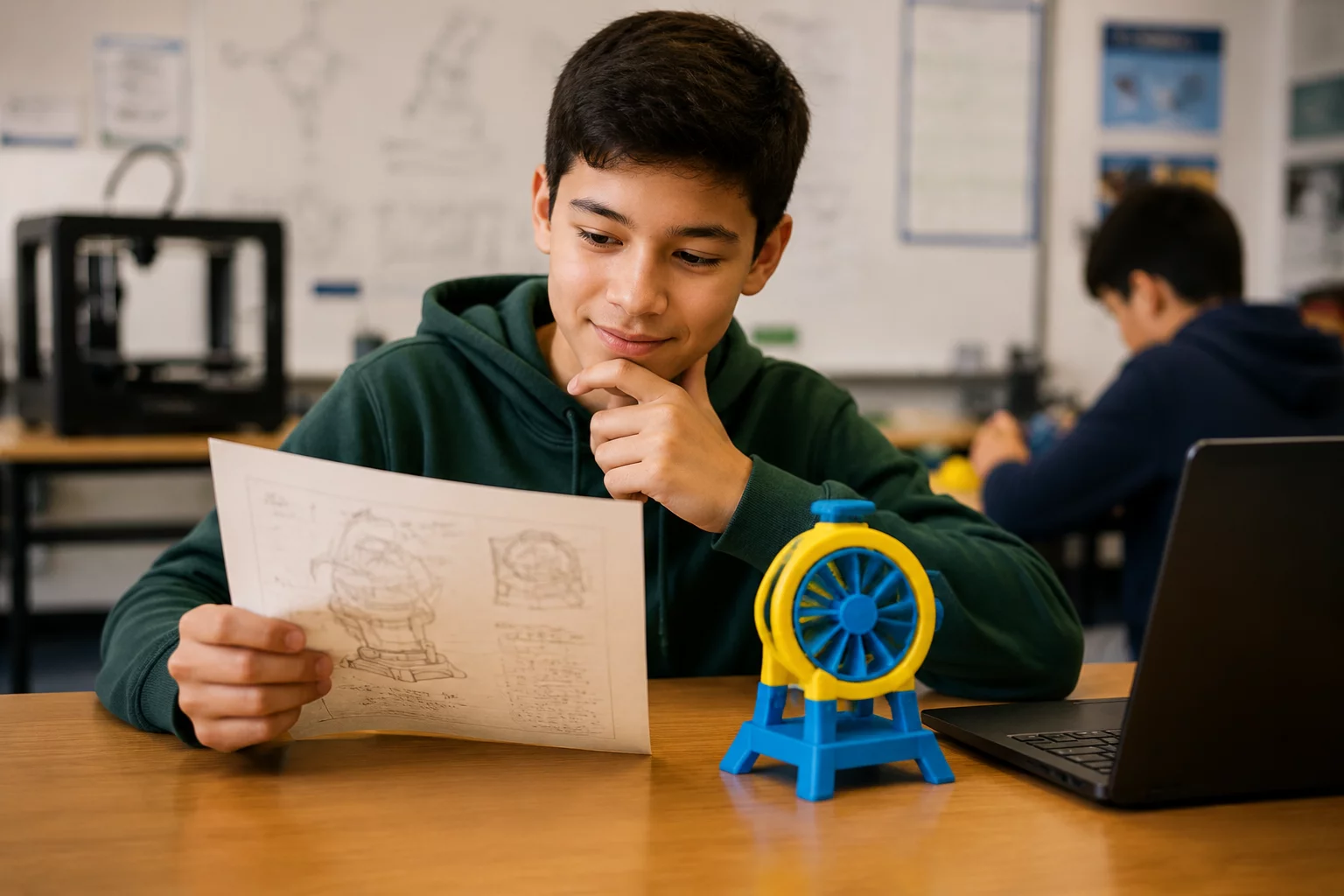
The Paradox of the Blank Canvas in 3D Modeling
When educators hand students an open-ended CAD assignment with unlimited dimensions and zero restrictions, the room often falls silent. Faced with infinite possibilities, young designers freeze. Without boundaries, deciding what to build or where to place the first geometric shape feels paralyzing rather than liberating.
Imposing deliberate boundaries changes everything immediately. When a project card mandates fitting an entire mechanism inside a 60 mm cube or relying strictly on three basic geometric primitives, the problem shifts from abstract art to concrete engineering. Students stop agonizing over what could exist and start figuring out how to make a functional solution work within strict limits.
Boundaries do not restrict imagination; they channel cognitive energy directly into solving tangible mechanical challenges.— Sarah Jenkins, STEM Curriculum Specialist
Why Structural Limits Trigger Better Engineering Solutions
In classroom makerspaces, constraint-driven challenges force students to justify every millimeter, fillet, and volume calculation. Setting boundary rules produces distinct educational advantages:
- Rapid Prototyping Cycles: Strict envelope limits drastically shorten 3D print times, enabling multiple test-and-tweak loops within a single class period.
- Deeper Geometric Reasoning: Restricting primitive shapes obliges learners to combine, subtract, and group solids strategically rather than downloading bloated pre-made meshes.
- Objective Design Evaluation: Caliper tests and physical go/no-go gauges instantly show whether a print meets tolerances, removing subjective grading debates.
- Material Efficiency Awareness: Requiring lightweight or flat-surface geometry instills real-world manufacturing ethics and minimizes wasted filament.
When students operate under clear constraints, failure becomes informative rather than disheartening. A part that misses a 25 mm desk slot by two millimeters points to a specific measurement flaw to correct on the next iteration.
Implementing 2–4 Rule Protocols in Your Classroom
To introduce constraint-based thinking into Tinkercad or hands-on STEM units, apply a tiered limitation protocol before opening the software:
- Define One Physical Dimension: Lock down an exact bounding envelope, such as a 50x50x20 mm footprint or an exact edge clip gap.
- Restrict Primitive Components: Challenge teams to construct the functional prototype using no more than three primary CAD shapes.
- Enforce a Single-Feature Modification Loop: Require every second-generation design to reduce volume or print time by at least 15% while preserving load capacity.
By standardizing these parameters, teachers transform ambiguous modeling sessions into dynamic labs where creativity thrives under structure.
Discussion & Peer Reviews
Dr. Elena Rostova
STEM Educator 08/10/2026The parametric constraint prompts revolutionized our university robotics lab. Limiting students to 3 distinct CAD primitives forces actual geometric reasoning instead of brute-force modeling.
PARAMETER CHECK: [Wall Thickness >= 2.4mm] // Status: PASSEDChloe Bennett
Middle School Educator 08/12/2026Using the 'Hold Two Objects, Not Three' prompt completely changed how my 7th graders approached desk organizer units. They actually took real caliper measurements before sketching.