Cable Organizer Challenge
Create a compact, friction-fit cable manager designed specifically to secure cords along narrow desk edges using minimal geometric primitives.
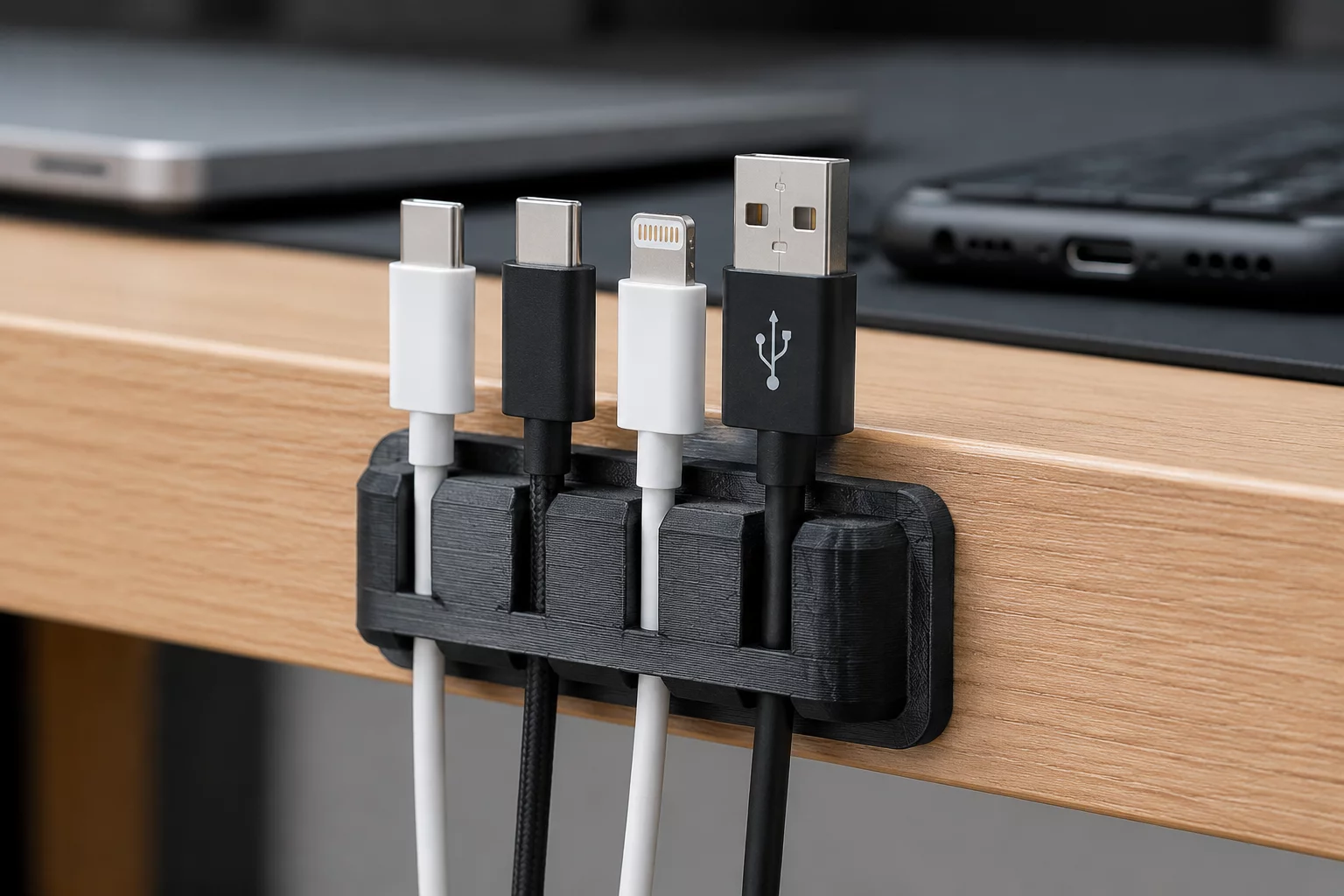
Engineering Context & Goal
Classroom workspaces and student computer stations regularly suffer from cable chaos. Disconnected charger cords drop behind desks, tangled lines create trip hazards, and bulky commercial organizers fail to fit in narrow edge clearances. This challenge directs students to design a compact, functional cable manager tailored to operate within restricted spatial envelopes.
Rather than modeling an unconstrained container, participants must construct their geometry around precise cable diameters and desk edge profiles. By combining friction retention slots with a minimal solid volume, the final printed part must grip cables firmly during routine use while allowing fast single-handed cord removal.
Key Learning Outcomes
- Master dimensional tolerance calculation for snap-fit cable channels (0.4mm to 0.8mm clearance).
- Apply boolean subtraction techniques to generate self-retaining flexure slots without complex assemblies.
- Optimize 3D print layer line orientation to withstand daily lateral tugging forces.
Mandatory 2–4 Design Constraints
Each student must verify full compliance with all parameters below before exporting STL files for production.
Maximum Envelope: 45 x 25 x 20 mm
The finished solid geometry must fit strictly inside a 45 x 25 x 20 mm bounding box, preventing excessive desk space usage and keeping print times short.
Maximum 3 Primary Solids
Construct the main body and cutout geometry using no more than three primary CAD solids (such as a base cuboid and two cylindrical subtraction shapes).
Dual Channel Retention (4mm & 6mm)
The organizer must securely seat two distinct cable gauges: one standard USB-C cable (4mm diameter) and one braided laptop power lead (6mm diameter).
Evaluation & Physical Verification
Assess the model against physical tolerance standards using the structured verification table.
| Evaluation Metric | Tolerance Target | Passing Criteria |
|---|---|---|
| Desk Interface Fit | ±0.3 mm Channel Slot Gap | Holds firmly to desk lip or flat surface without slipping or rocking during cable insertion. |
| Primitive Solid Count | ≤ 3 Primitives | Constructed strictly with allowed boolean combinations without unconstrained loft additions. |
| Load Capacity | 3.5 N Retention Force | Prevents cables from sliding backward under gravitational pull while allowing intentional unplugging. |
Educator Feedback & Peer Reviews
0 Verified NotesNo lab observations recorded yet. Be the first educator or maker to submit your test results!
Submit Lab Observation
Share print results, tolerance outcomes, or classroom adaptations for this card.