Phone Stand Iteration
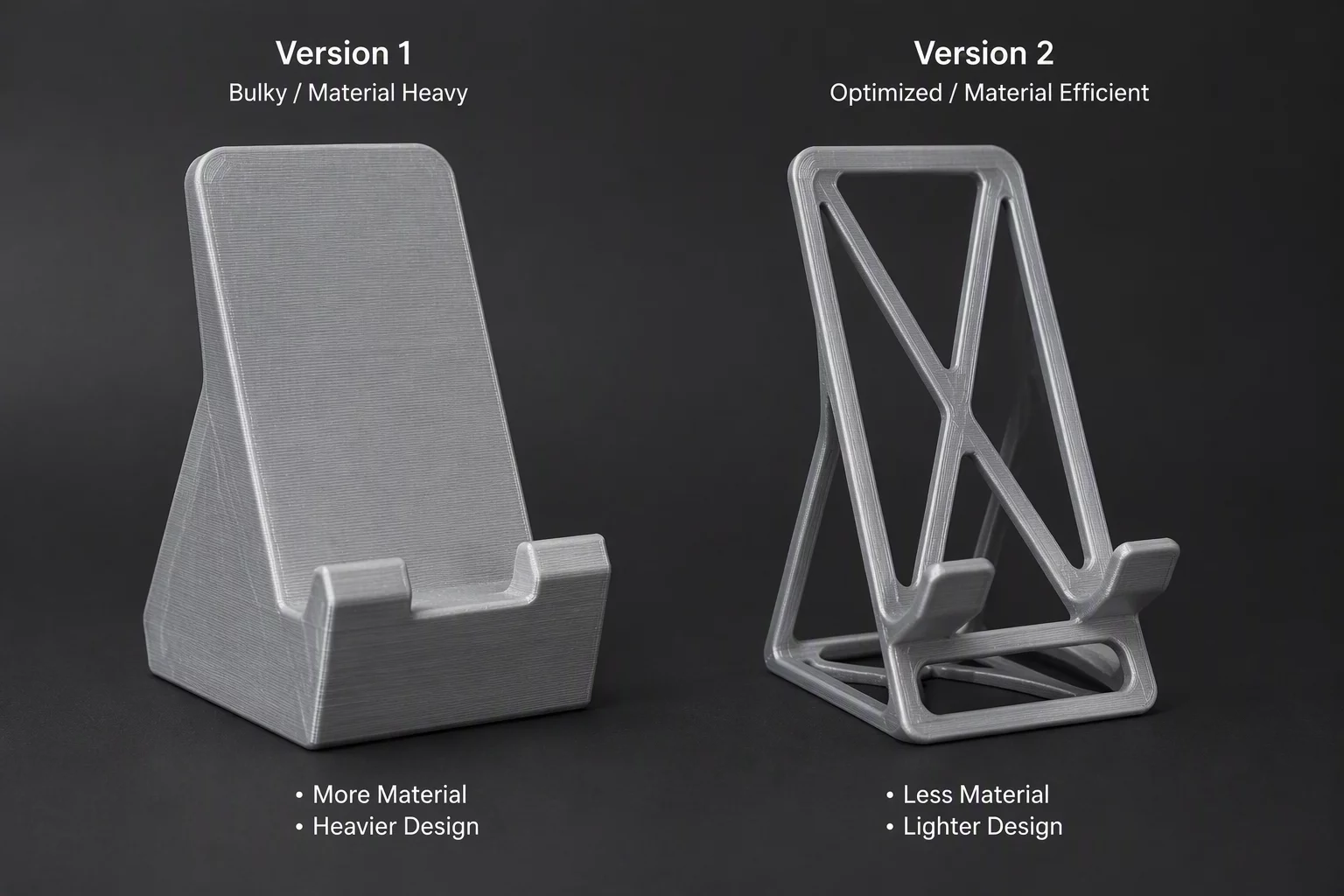
Make a second version of a desktop phone stand that uses at least 20% less material while maintaining total balance and viewing ergonomics.
Engineering Context & Goal
In manufacturing and product design, generating a working prototype is merely the initial phase. Real-world engineering cycles demand iterative refinement to eliminate excess material, decrease 3D printing durations, and optimize cost efficiency without degrading mechanical reliability.
This challenge begins with a bulky baseline phone stand model. Students analyze stress distribution and remove material from non-load-bearing sections using geometric cutouts, hollow pockets, or lightweight truss architecture. The goal is to trim solid plastic volume by at least 20% while holding a phone upright securely in both landscape and portrait orientations.
Key Learning Outcomes
- Execute methodical volume analysis and mass inspection within 3D CAD environments.
- Apply strategic coring, ribbing, and void geometry to lower plastic weight without inducing flex.
- Maintain center-of-gravity balance to prevent tipping during screen interaction.
Mandatory 2–4 Design Constraints
Each student must verify full compliance with all parameters below before exporting STL files for production.
Minimum 20% Material Reduction
The iterated 3D model volume must measure at least 20% smaller than the original baseline stand solid body.
Dual Orientation Support
The stand must reliably hold a standard smartphone in both vertical portrait and horizontal landscape orientations without tipping over.
Maximum 4 Cutout Operations
All material reduction must be completed using no more than 4 distinct boolean cutout or hole shapes added to the original model.
Evaluation & Physical Verification
Assess the model against physical tolerance standards using the structured verification table.
| Evaluation Metric | Tolerance Target | Passing Criteria |
|---|---|---|
| Desk Interface Fit | 80 x 70 mm Footprint | Rests flat on desktop surface without rocking or tilting during normal device placement. |
| Primitive Solid Count | Max 4 Cutout Solids | Constructed strictly with allowed boolean combinations without unjoined fragmented geometry. |
| Load Capacity | 250 g Static Device Load | Holds a standard smartphone without structural deflection or base tip-over when tapped. |
Educator Feedback & Peer Reviews
2 Verified NotesDr. Elena Rostova
STEM Educator 08/14/2026Our engineering students tested three iteration cycles. Forcing a strict 20% mass reduction made them think critically about load paths rather than merely trimming random corners.
PARAMETER CHECK: [Mass Reduction >= 21.4%] // Status: PASSEDSubmit Lab Observation
Share print results, tolerance outcomes, or classroom adaptations for this card.