Desk Hook Design
Design a sturdy, functional cantilever hook tailored for standard 25mm desk edges using a maximum of three geometric solids in Tinkercad or CAD.
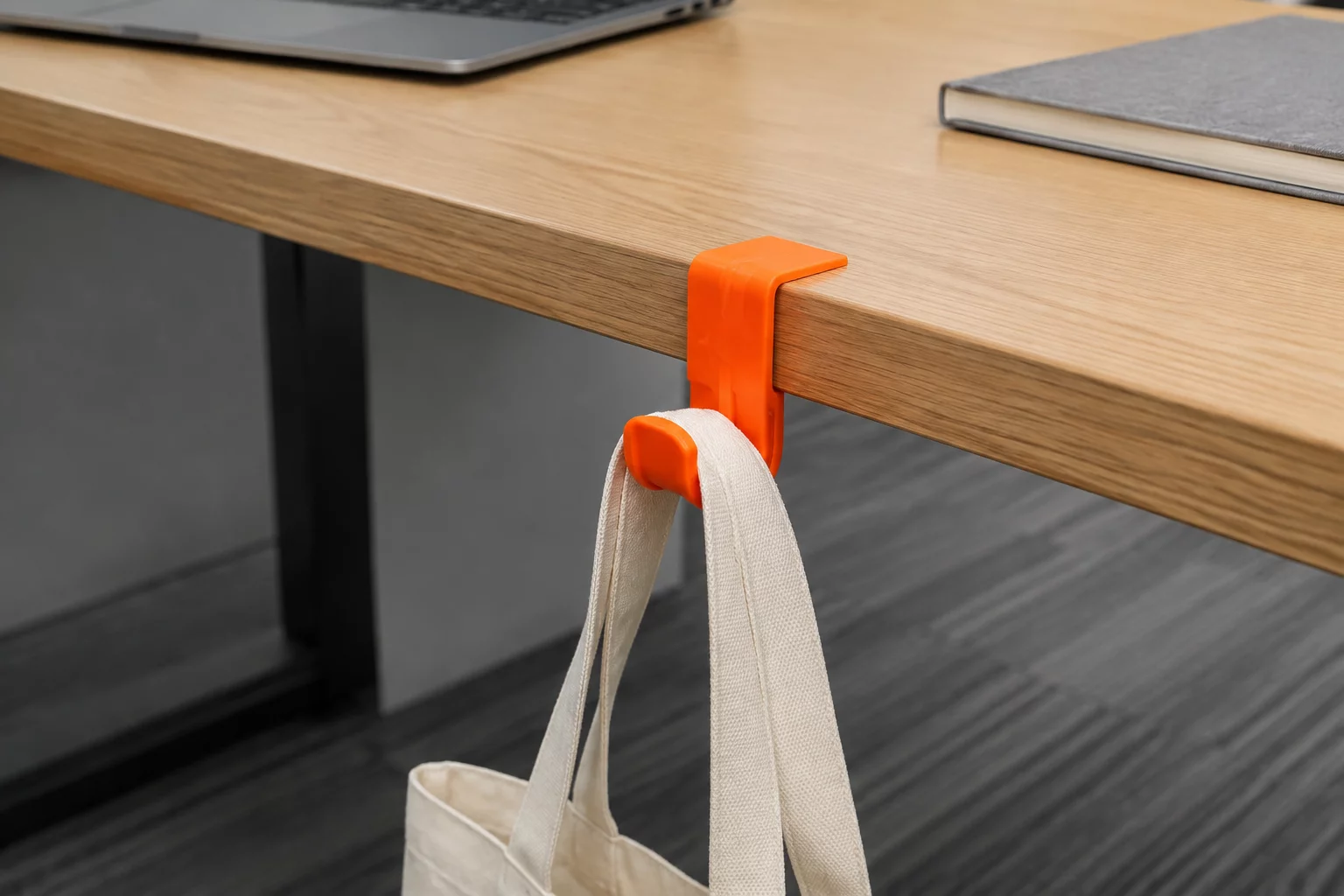
Engineering Context & Goal
Classroom desks and makerspace tables frequently run out of surface area once laptops, notebooks, and prototype components are laid out. Floor space becomes equally messy when backpacks and cables accumulate around student seating. Designing a friction-fit or gravity-balanced desk hook provides a direct solution by moving heavy bags off the ground without drilling holes into school furniture.
This challenge pushes students to solve structural cantilever leverage under tight geometric limits. Rather than building elaborate multi-part assemblies, learners must construct the entire load-bearing clamp and hook profile by grouping no more than three primary CAD solids. The final physical part must stay balanced under weight without sliding loose from a standard 25mm desktop edge.
Key Learning Outcomes
- Apply boolean subtraction and union operations using only 3 basic shapes.
- Calculate cantilever deflection and reinforcement gussets along load paths.
- Incorporate FDM print tolerances for a snug 25mm desk lip friction fit.
Mandatory 2–4 Design Constraints
Each student must verify full compliance with all parameters below before exporting STL files for production.
25mm Desk Lip Clamp Opening
The upper slot must measure between 25.2mm and 25.6mm to ensure an effortless slide-on fit over a standard classroom desk edge without wobbling.
Strict 3-Shape Composition
The finished 3D object must be created by uniting or subtracting exactly three primitive solids, such as a box, a cylinder, and a wedge or torus.
1.5 kg Minimum Static Load Capacity
The hanging loop or prong must sustain a 1.5 kg downward load test for at least 60 seconds without cracking or detaching from the desktop edge.
Evaluation & Physical Verification
Assess the model against physical tolerance standards using the structured verification table.
| Evaluation Metric | Tolerance Target | Passing Criteria |
|---|---|---|
| Desk Interface Fit | 25.4 mm (±0.3mm) | Holds 25mm thickness without slipping or permanent deformation. |
| Primitive Solid Count | ≤ 3 Primitives | Constructed strictly with allowed boolean combinations. |
| Load Capacity | 1.5 kg (15 N) | Supports test weight for 60 seconds without joint cracking. |
Educator Feedback & Peer Reviews
3 Verified NotesDr. Elena Rostova
STEM Educator 06/14/2026The parametric constraint prompts revolutionized our university robotics lab. Limiting students to 3 distinct CAD primitives forces actual geometric reasoning instead of brute-force modeling.
PARAMETER CHECK: [Wall Thickness >= 2.4mm] // Status: PASSEDLiam Thorne
Design Educator 08/11/2026We ran this 3-shape desk hook challenge with 8th graders. The 25mm edge constraint forced students to use digital calipers before designing in Tinkercad. It connected CAD directly to physical measurement.
TOLERANCE FIT: [Caliper Check: 25.4mm] // Status: VERIFIEDSubmit Lab Observation
Share print results, tolerance outcomes, or classroom adaptations for this card.